

















Each year, the shifting tides uncover parts of the past. To most people, fragments of glass, brick and pottery might seem like trash. But to a small community, they are treasures and clues to how people lived decades ago.
Beachcombing involves searching for and collecting naturally worn glass, pottery, fossils, rocks and other remnants that wash onto the shore after being eroded by the lake or ocean. One experienced beachcomber, Shea Alltmont, regularly hosts seminars on how to find the best items. Alltmont describes beach glass as “trash that had become treasure over decades.” This natural recycling process is part of what makes the activity so interesting to many people; each item carries its own history and story.
Beachcombing has deep historical roots connecting everyday life to the past. For centuries, people discarded broken or unused items such as glass bottles, pottery and jars into bodies of water. Alltmont described how the early American settlers brought glass and pottery from Europe, and broken glass ended up finding its way into oceans and lakes. “Glassmaking or glass forming was actually one of the first industries in the United States,” Alltmont said. Over time, natural processes like water erosion, sand abrasion and salt exposure smoothed and frosted these discarded objects. “Once the items are thrown into the lake … the pieces are slowly worn down,” Alltmont said.
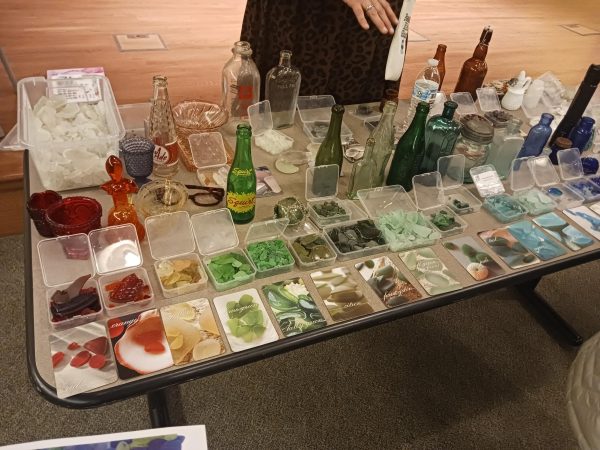
Participating in beachcombing transforms a simple walk along the shore into an educational adventure. With each wave revealing new treasures, participants are reminded that the shoreline is not just a place for recreation but a living archive of stories waiting to be uncovered. One passionate attendee, Rhonda Accordino, said, “It’s nice to get some more information from someone who knows what they’re talking about.”
For many participants, these seminars offer discoveries that go beyond glass and pottery. “I learned about the lucky stones,” said attendee Bea Traun. Learning about unique finds adds another layer of excitement to beachcombing, encouraging participants to appreciate the diversity of treasures that Lake Erie has to offer.
Lake Erie glass tends to be younger and comes in a smaller range of colors compared to sea glass found on ocean shores. Much of the glass that washes up along Lake Erie originates from old bottles, jars, and industrial waste that entered the lake during the 1900s, so its aging process is shorter. Noting that those colors were rarely produced in large quantities and often came from specialty items like signal lenses or decorative glassware. Because of this, finding a piece in any of those shades is considered a major score among collectors. “More commonly, beachcombers find white, green, or brown glass,” Alltmont said.
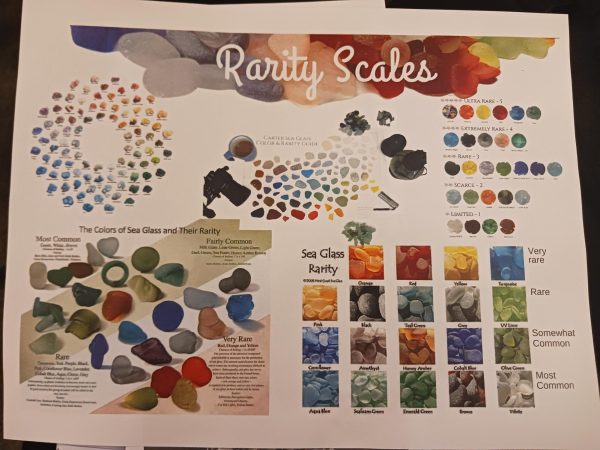
Lake Erie glass tends to be younger and comes in a smaller range of colors compared to sea glass found on ocean shores. Much of the glass that washes up along Lake Erie originates from old bottles, jars and industrial waste that entered the lake during the 1900s, so its aging process is shorter. Alltmont noted that those colors were rarely produced in large quantities and often came from specialty glassmakers, making them some of the rarest finds along Lake Erie.
Over time, Lake Erie’s waves and rocky shorelines frost the glass, but the pieces often keep their sharper edges and a lighter frosted texture than ocean-tumbled glass, giving them a look that experienced beachcombers can identify instantly. Found objects aren’t just things; they can be stories and histories. There is value in learning about an object’s origins and history. Each piece found along the shore, whether it’s a shard of glass, a smoothed stone, or a fragment of pottery, invites us to imagine the lives that came before us and the journeys these objects have taken.
In sharing discoveries and knowledge, beachcombers foster a sense of community and stewardship for the shoreline. Ultimately, the treasures uncovered are reminders that our environment is shaped by both nature and human history, and that even the smallest artifact can hold a world of meaning for those willing to look closely.