







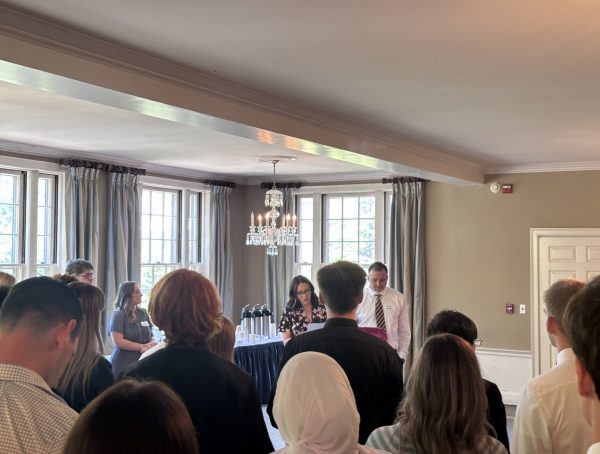
On May 21, the Practical Communication class held its networking event at the Clifton Club.
This networking event, envisioned by Practical Communications teachers Gray Cooper and Aimee Guzowski, has been anticipated in multiple ways. Students in the class spent considerable time preparing in the weeks leading up to the event, as it served as their final exam.
The event was initially scheduled for May 18 but was canceled because of an unexpected gas leak on the high school campus. Were it not for the admirable grit of the aforementioned teachers to resolve the scheduling of this event, the students of this class were able to have a truly unique opportunity to put the communication skills they learned to the test.
Practical Communication: The Class
Practical Communication is a semesterlong class exclusively for seniors taught by Gray Cooper — a veteran English teacher at Lakewood High — and Aimee Guzowski, an intervention specialist, co-teacher of English classes and career shadowing facilitator for seniors at Lakewood High.
As the name suggests, the purpose of the class is to improve the communication skills of high school seniors in a world where younger generations are increasingly seen as lacking basic communication skills due to isolation caused by a multitude of factors in a digital world.
The state of the class has gone through many iterations throughout the 11-year tenure of Cooper and Guzowski, evolving from a worksheet-oriented course into one that teaches students how to manage their lives, create valuable habits, create systems that point students towards their goals, conduct interviews regarding careers and confidently communicate through unorthodox drills and practices best-tailored to simulate the real world.
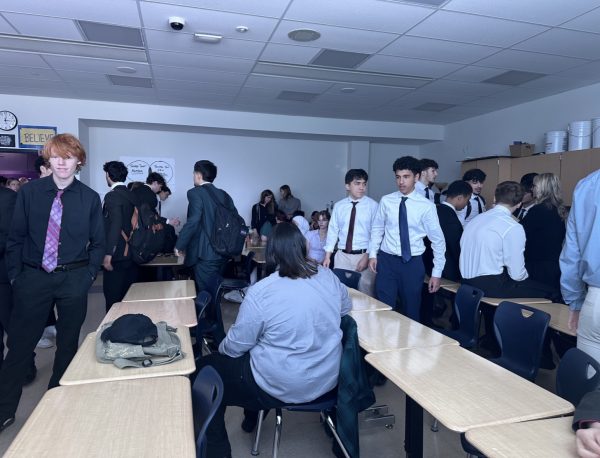
The class has students participate in all that is done; students by no means can opt out of doing even one of the assignments. This type of philosophy of teaching stems from the idea that the real world does not offer anyone scheduled time-outs when an individual does not feel ready or motivated, which is reflected in the class’s emphasis on active communication and engagement with peers as an essential life skill.
As such, for a class built around unconventional methods and experiences, it is only fitting that the final reflects that same character.
The Networking Event and Its Challenges
During the networking event, students engage with unfamiliar people in a professional setting outside of their comfort zones. The professionals they meet are successful members of the surrounding community, and students are tasked with meeting as many people as possible and holding professional conversations about careers, backgrounds and shared interests within a one-hour time frame.
Due to the number of students and professionals attending the event, it was split into three one-hour slots to enable students and professionals to have one-on-one conversations without the risk of multiple students being left without a professional to talk to for a significant portion of the time.
As the final event, students in Practical Communication put the skills they learned to the test. The event serves as the crown jewel of the course, as it physically represents what students have learned over the semester.
“It’s a non-traditional final exam – for sure – but we felt like it’s important to be able to assess students’ skills in an authentic way … we felt like the best thing would be [to] get them out in front of people that they’ve never talked to before, people that they feel a little intimidated by, to really practice those skills … I think it’s really important for somebody who’s just getting ready to start in their real life out in the real world [to] have the opportunity to be in that space and do so with confidence,” said Cooper.
One example of these unorthodox practices providing real results is that of Aidan Jason Michael Benjamin, a senior at Lakewood High School who is in Practical Communication. Through varied scenarios and practices, the class not only exposed him to real-life situations but also prepared him to handle them.
“Because I got to talk to a bunch of adults with professional careers and people that have just achieved much more than me … it’s kind of intimidating. That’s really all it is. I’m [also] seeing some familiar people, like one of my friend’s dads is gonna be there, [and] my therapist,” said Benjamin.
Due to the nature of securing professionals for the networking event and scheduling the venue, the teachers have to do some networking themselves. This includes making cold calls, maintaining contacts within their network and developing new ways to find professionals appropriate for the event.
“We’ve had people that have come since day one, and it’s like 30 to 50% of faces I’ve seen before [return]. Then a couple [of] years ago, Cooper and I said, ‘Why don’t we have our students reach out to people in the fields that they would like to go to and have them extend the invitation?’ I had a student who wanted to be a mathematician, so he found a professor from Case and was [asking] him questions about his career. [He] eventually [asked], ‘Well, would you come to our event?’ That person from Case [who] never had any association with Lakewood High School came to the event, [and] that [became] a new way of getting kids to invite people in their prospective fields,” said Guzowski.
The cancellation of the event due to an unexpected gas leak led to many complications, making it seem that reviving the event was an insurmountable task. It required calling and notifying all the busy attendees, the Clifton Club and the bussing company of the new date. However, as this class entails, it is imperative to turn obstacles into new opportunities.
“Friday, I could have cried – which I did at one point when I called Cooper – but my other choice was [to] move forward, and that’s what [Cooper and I] did. There were still moments over the past couple of days where we were just frustrated, but we didn’t let that stop us from giving [the students] all this opportunity. So our choice of moving forward – the only one – [was] because if we had buckled and said, ‘Never mind, we’re just going to cancel it,’ it would have undermined everything we were teaching [our students],” said Guzowski.
As the teachers demonstrated, they turned an unfortunate setback — where most might have thrown in the towel — into an opportunity to make the event even more special, ultimately increasing attendance compared to the original plan.
Looking Forward
After a successful networking event in which students met people who will be significant in their future careers, it wrapped up a semester of hard work and determination to continue despite struggles that were presented. All things considered, the core of the event will not change, but because a significant portion of the professionals were booked for the entirety of the event, the teachers found it necessary to add catering moving forward.
“I think it went great, students rose to the expectations, everybody performed well, [and] it was an awesome event. The community showed up to support us; it was fantastic,” said Cooper.