

















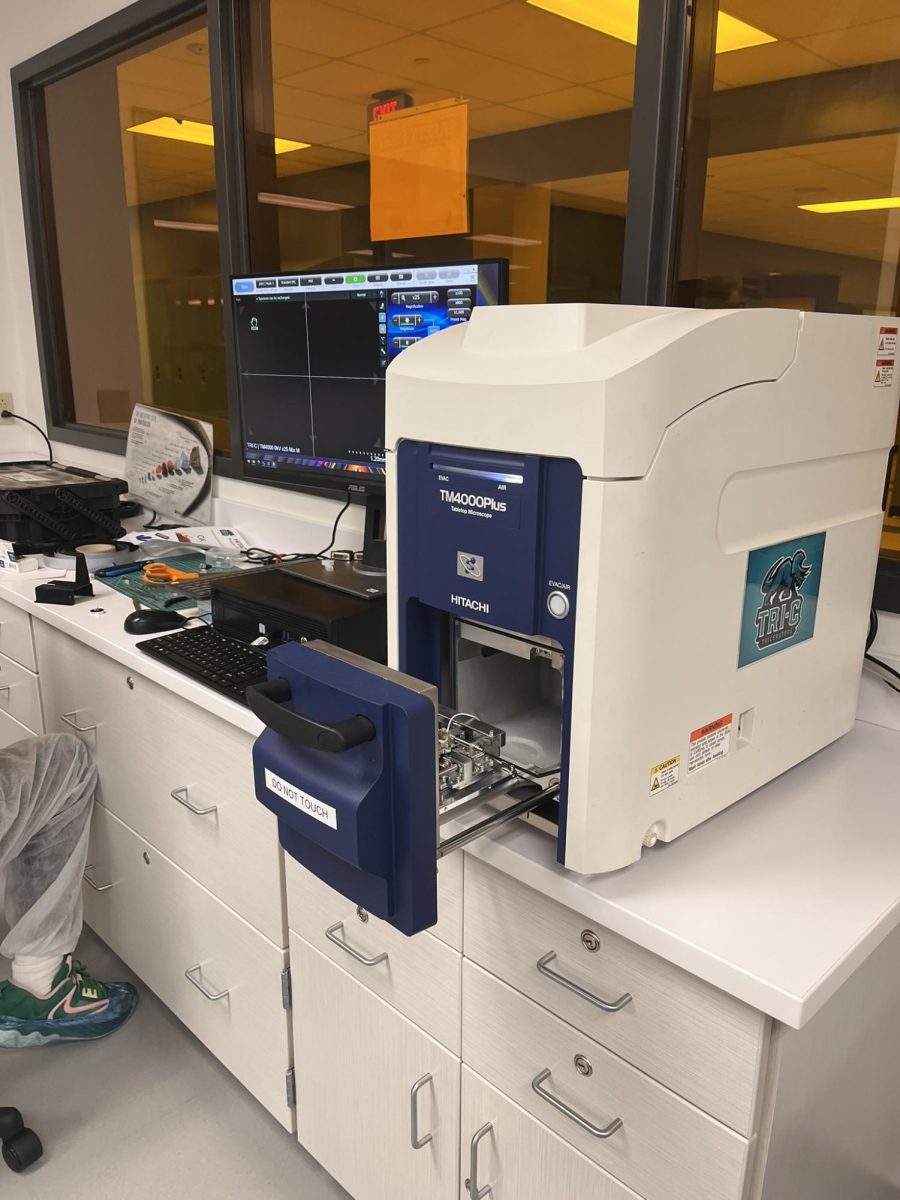
Invented in the 1590s, the microscope is a powerful tool that can magnify objects from the largest to the smallest sizes. The tiniest things are thankful for microscopes because without them, humans would never have known they existed. Like 99% of people at Lakewood, we wouldn’t have known that the scanning electron microscope existed without it being graciously loaned out to us.
There are only 13 scanning electron microscopes (SEM) in the world that are transported globally, and Lakewood High School received the honor of having one for the first time in its history. These microscopes are no ordinary Walmart Christmas gift microscope; they are machines worth hundreds of thousands of dollars. The one specifically at Lakewood can magnify up to 100,000 times.
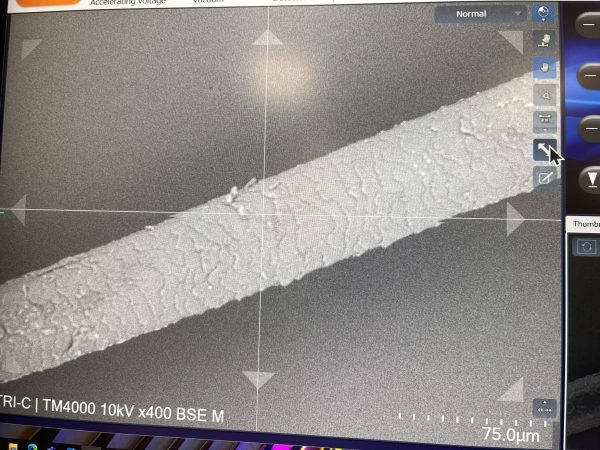
The true question to ask is how Lakewood High School got its hands on this one-of-a-kind device. “I was perusing LinkedIn and saw a post from a guy saying it was at the Natural History Museum… and I sent an email, shooting my shot, and here we are,” said Kyle White, head of the MEMS program at Lakewood High School. This particular SEM belongs to Cuyahoga Community College—Tri-C—and they loan it out for free to institutions and schools so the public can learn about microscopes and what everything around us is really made of.
This year, in collaboration with West Shore Career-Tech, Lakewood opened a new program called MEMS, which stands for micro-electromechanical systems. In layman’s terms, students are learning how to make computer chips, like the ones used in phones. They are using technologies such as soldering, clean rooms, and yellow light to create the chipmakers of tomorrow.
For the less tech-savvy, the term “yellow light” may seem like a complex invention, but it’s something everyone at Lakewood High School has definitely seen. With all the recent renovations, there may be small things people miss here and there, but no one has missed the new MEMS clean room. Right by the art atrium on the second floor, it’s a large room with yellow lights and yellow-tinted windows where the SEM is kept.
If students were lucky enough, their teacher may have taken them down for a lesson, or maybe they had found themselves there by their own curiosity. But one thing is for sure: everybody wonders how it works. “So let’s start with the tungsten. Basically, it gets heated up and emits electrons; it is like a flashlight. Then the machine reads it just like normal light, but it just uses electrons instead,” said Liam Jantz, an 11th-grader in the MEMS program.
It’s in the name: SEM, or scanning electron microscope. Compared to an electron, a wavelength of light is millions of times larger, which is why electrons are needed. In these microscopes, to achieve the level of detail they do, light simply wouldn’t be feasible to operate them.
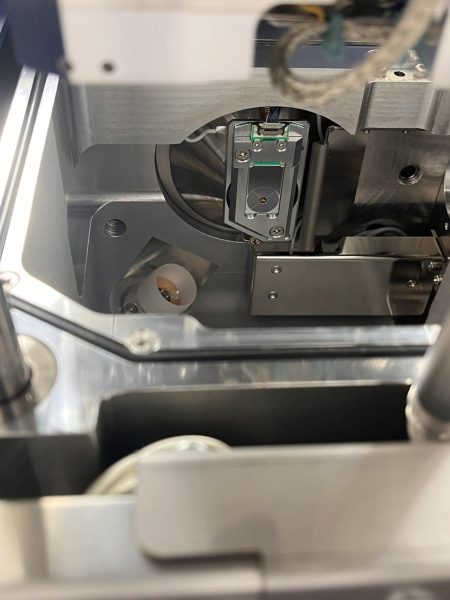
Since a photon wave is too big, air would be an even bigger problem. Before viewing the sample, a user must wait about 3 minutes while it sucks out the air, or they’ll get a blurry picture. The air also prevents electrons from moving. Once a vacuum is created around the sample, electrons are blasted onto its surface and then picked up by electron detectors, which produce a clear image for the viewer.
MEMS students are utilizing the microscope for their learning as well. “Today, my teacher showed me a broken circuit board and a copper wire at a microscopic level,” said Ben Bernad, a MEMS student. They can also examine their own solder under the microscope to see what their work consists of and how it can be improved.
This rare opportunity is only at Lakewood until the end of the week, Nov. 21. If you are interested or curious about what the SEM has to offer, do not hesitate to contact Mr. White, who would be more than happy to set up a time for you to see the microscope in its entirety.