


















After earning Bronze recognition last year, Lakewood High School advanced to Gold Distinction on the 2025 AP School Honor Roll, a change that reflects the school’s growing emphasis on student opportunities and academic rigor.
The College Board’s AP School Honor Roll recognizes high schools that help expand opportunities for Advanced Placement courses to their students. This allows more opportunities to open up, encouraging students along the way to take rigorous courses and step outside their comfort zone. Schools earning Gold Distinction must demonstrate a high level of commitment to both student participation and exam success.
“The numbers that we are seeing are larger than ever in terms of the number of kids taking it. The majority of the students are taking those exams associated with the course,” said Bridgette Firstenberger, associate principal of Lakewood High School.
The increase in exam participation suggests that more students are not only enrolling in AP courses but also committing to completing the associated exam. Lakewood High currently offers 22 AP Courses. While AP Art History runs every other year based on enrollment, the overall program is thriving. This year, there are 434 students enrolled in at least one AP class, with 777 AP exams being given out for the 2025-26 term.
Looking back at the 2024-25 school year, when the school earned its Bronze recognition, the numbers were still high, but not as high as they are now. With 449 students taking at least one AP class, only about 676 exams were given—a 101-exam increase for the current year.
“I think one of the challenges is, and it’s a very good challenge to have, is helping students understand that they can be successful in AP,” Firstenberger said. “Sometimes I feel like students see AP or see the words advanced placement, and automatically think, ‘Oh, I’m not smart enough for that.’ You absolutely are smart enough for that, and if you’re willing to work hard, then there’s a place for you in that class.”
Firstenberger’s comments reinforce the idea that AP courses are for more than just those who view themselves as the “top” students. The shift aims to create an inclusive culture where success is rooted in effort and support.
“It helps you with problem solving and reading, it’s not just science skills. You’re learning math skills and again, like reading comprehension and synthesizing material,” said Karen Alten, an AP Biology teacher with over a decade of experience.
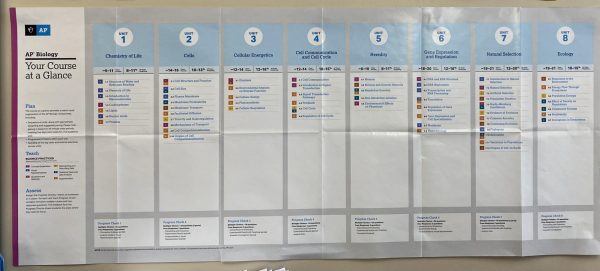
In Alten’s words, helping students develop a well-rounded academic skill set, AP coursework—like AP Biology—prepares students for the academic demands of college-level classes. She credits the recent Gold Distinction to the students’ own dedication.
“It’s not about me, it’s about you. You guys did all the hard work, and it shows, and so, yes, it’s nice to be part of that, right? So, the work ethic of the students is amazing,” Alten said. “I see that some students think that they’re not good at science, and then all of a sudden they’re pretty good at science. And even if they don’t get like, 100% of it all the time, they can still look at it, and look at all of the things you learned and be like ‘Whoa!’”
Alten’s comment suggests that a supportive classroom environment encourages students to take risks, learn from mistakes, and discover strengths within themselves and the classroom they didn’t think they had, which Alten’s class offers, as well as other AP classrooms.
“I hope, as we have, the numbers have grown from one small class to two really huge, stuffed classes. So that would be great if it would continue to grow, because I think it’s a great, challenging class.” Alten said, explaining her hopes for the future of AP Biology for years to come.
Newer additions to the curriculum have also contributed to the Gold Distinction. AP African American Studies has been offered at Lakewood for four years, with enrollment growing annually.
“It’s an opportunity for kids from diverse backgrounds to get their history and culture and politics and forms of expression at an AP college level,” said Austin Sparks, who teaches the course. “And it gives kids more opportunities for more AP history.”
AP African American Studies dives deep into the African Diaspora (Unit One), which has never been taught before at a high school level, and also dives deeper into the African American narratives and historical contexts that have been set in stone.

“A lot of times, African American people throughout history… are kind of put in a box of like, all thinking the same. And that’s not true at all,” Sparks said. “A lot of African American people had different takes on what was best for black communities, throughout.”
By addressing the conceptions that are far too commonly placed that African American historical figures, and individuals in general, shared a single viewpoint, Sparks illustrates how the course encourages students to analyze differing perspectives and ideals within Black History without just memorizing for tests.
“I fully understand as an educator, like five years from now, when a kid leaves my class, they’re not going to memorize every single thing that I taught them. But I think the bigger picture is, just like you have more cultural understanding of African American communities. And again, I just think as a society, a course like this will bring less ignorance and more understanding of people who are similar or different to them in our communities.” Sparks said.
As the Lakewood community celebrates its Gold Distinction, the focus remains on the future.
“So I guess just as a school community, I want teachers and students to continue to challenge themselves with the development of AP courses and to enroll in AP courses,” Sparks said.
For the LHS community, the Gold Distinction is a moment of pride and reflection for the school. Showcasing not only AP performance, but also a shared belief in pushing students to reach their full potential both inside and outside the classroom.