













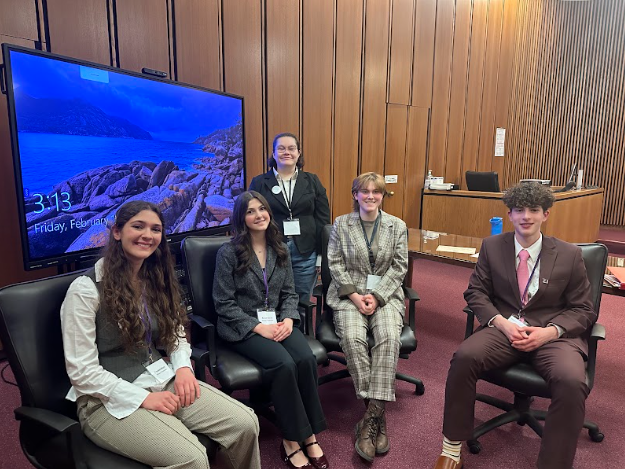
On Feb. 13, Lakewood High School’s Mock Trial club showcased its talent at the Downtown Justice Center after months of preparation. The veteran members and newcomers were presented with a complex case this year, providing an opportunity to practice problem-solving in uncertain conditions.
Since Joe Lobozzo became the advisor, the club has seen significant growth. During the first four years of Lobozzo’s tenure, Mock Trial consisted of a single 10-student team. Now, due to an influx of enthusiastic freshmen eager to carry the mantle, the club fields two teams.
“I was kind of roped into it … Mr. Shields, who is a lawyer in Lakewood and has daughters who went here, was very tenacious that we keep the club going. He kept contacting our principal at the time, Mr. Walter, and eventually Mr. Walter came to me and asked me to please advise [Mock Trial] so that Mr. Shields won’t keep calling him,” Lobozzo said.
“I was only expecting to do it for a year or two until we found somebody else – it’s been six years now,” he added.
With Lobozzo serving as adviser, students take an active role in running the club and setting meeting days, alongside practicing lawyers such as Dan Shields, Amelia Leonard and Jennifer McTernan. The attorneys help students unpack the more than 200 pages of the case file provided each year.
Every year, a new case file is generated by the Ohio Center For Law Education (OCLRE), an organization that offers and administers Mock Trial competition in Ohio. Each case is unique, featuring different characters and legal arguments — such as last year’s case involving artificial intelligence in Denver Saidi v. Wyatt Latu and this year’s case, State of Buckeye v. Morgan Remy.
“This year’s mock trial case centered around the Fourth Amendment, and to what extent we have rights to our DNA … For each team, you have three witnesses [who] mainly support your case [but still] offer a little bit of leverage for the other team,” said senior Maya Trempe, co-captain of the club.
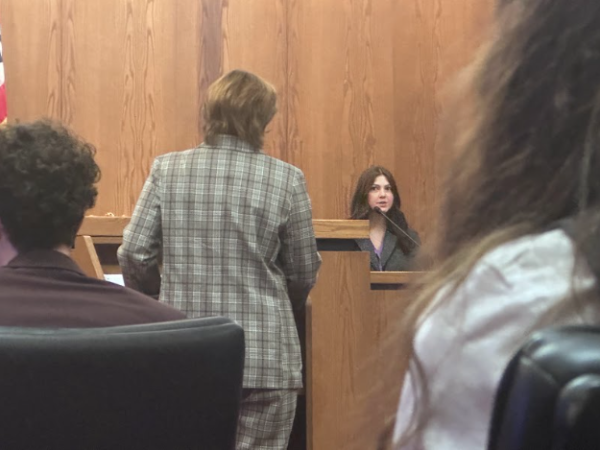
“[However,] some witnesses were just completely flipped. Defense had a witness whose [testimony] truly supported the prosecution, so we just kind of had to make that work for us, which was definitely challenging,” Trempe said.
A club’s success depends on its leadership, and this year’s leaders took on significant responsibility. Other than trying to account for the types of arguments, Supreme Court cases and witnesses that would be used, they had to coordinate an ever-fractured student body. Many Mock Trial members participate in other extracurriculars that conflict with the club’s usual Thursday meetings. The biggest issue was “just making sure everyone’s doing what they’re supposed to be doing, ‘keeping all my ducks in a row,’” said senior and co-captain Gwen Hongosh.
While leadership is important for ensuring a cohesive plan to execute on competition day, all club members are equally essential. A key role in Mock Trial is the attorney, whose job is to present a case supporting their side’s witnesses or which challenges the opposing witnesses. Lawyers direct their witnesses and cross-examine the opposing team’s witnesses on competition day, using facts from the case file.
“You highlight [the] things that support your position [and] don’t. You try [to] make your witnesses out to be the best person ever, and you try [to] find holes in your opponents’ witnesses. The most difficult part [is] tying it all together, [as] there’s lots of different elements involved. Then you have to make a closing or opening statement and tie all of that together,” said senior Amelia Diemert, one of the prosecution attorneys on Team One.
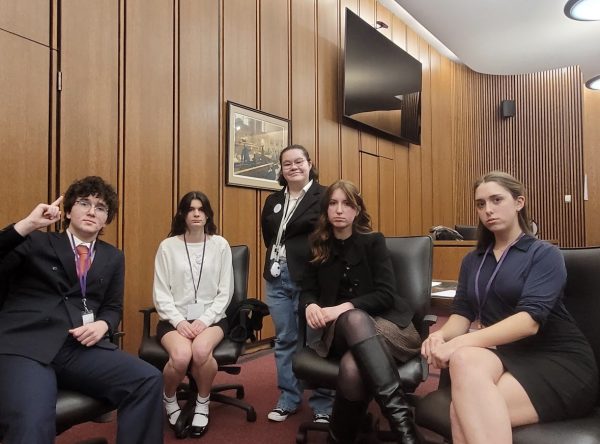
On competition day, although the team did not advance to regionals, two students received outstanding witness awards, and one received an outstanding attorney award. “I’m really proud of the students this year, and they should be mentioned. Tarik, Peyton, and [Amelia] were all recognized, and that’s a really great haul — a prize haul for us this year. I’m super proud of that,” said Lobozzo.
Attorneys aren’t the only ones challenged on competition day; witnesses also face a tough task. Witnesses never know what questions the opposing attorney will ask during cross-examination, so they must prepare by memorizing the witness’s testimony. “The most challenging questions I was asked [were] all the questions that were asked of me on cross-examination, because the lawyer that was doing cross-examination was phrasing the questions [in a] confusing [manner],” said sophomore Lincoln Yeung, a Team Two Defense team witness playing the character of Archer Morales.
On competition day, Team One Prosecution faced a unique case. OCLRE rules require each attorney to conduct a direct examination, cross-examination, and either an opening or closing statement. Rocky River’s defense team instead had one lawyer handle both statements, both direct examinations, and both cross-examinations of the witnesses called by the prosecution team. This required the presiding judges to recess and consult with organizers to determine how to proceed. About an hour later, the judges returned and told both teams to continue as planned, noting that scoring might be unusual due to the circumstances. Rocky River had to forfeit shortly thereafter because their bus had to leave, resulting in an automatic win for Lakewood.
Despite not advancing to regionals, all Mock Trial members gained valuable public speaking experience and had a great time. “I am so impressed and proud of our team for how [they held themselves] accountable. Everybody accounted for their own work so well, and they got the job done. So many people had to step into new roles, going from a timekeeper or [a] background team member to someone with a prominent role,” said Trempe.
What lies ahead for this club is unknown. Next year, new leadership will be appointed, and a total of seven members will be graduating this year. Despite the uncertainties, it’s clear that this year’s freshmen and newcomers will give the same dedication and effort they showed this year.
“It’s challenging sometimes, [as] January gets very busy, but I never regret it. It’s so fun to watch,” said Lobozzo. “There [are] moments when I know that it’s really worth doing, [such as] when I watch students cross-examine in their practices, or when we go down to the real courts and do it. It’s such an authentic experience. It’s so worth it.”