






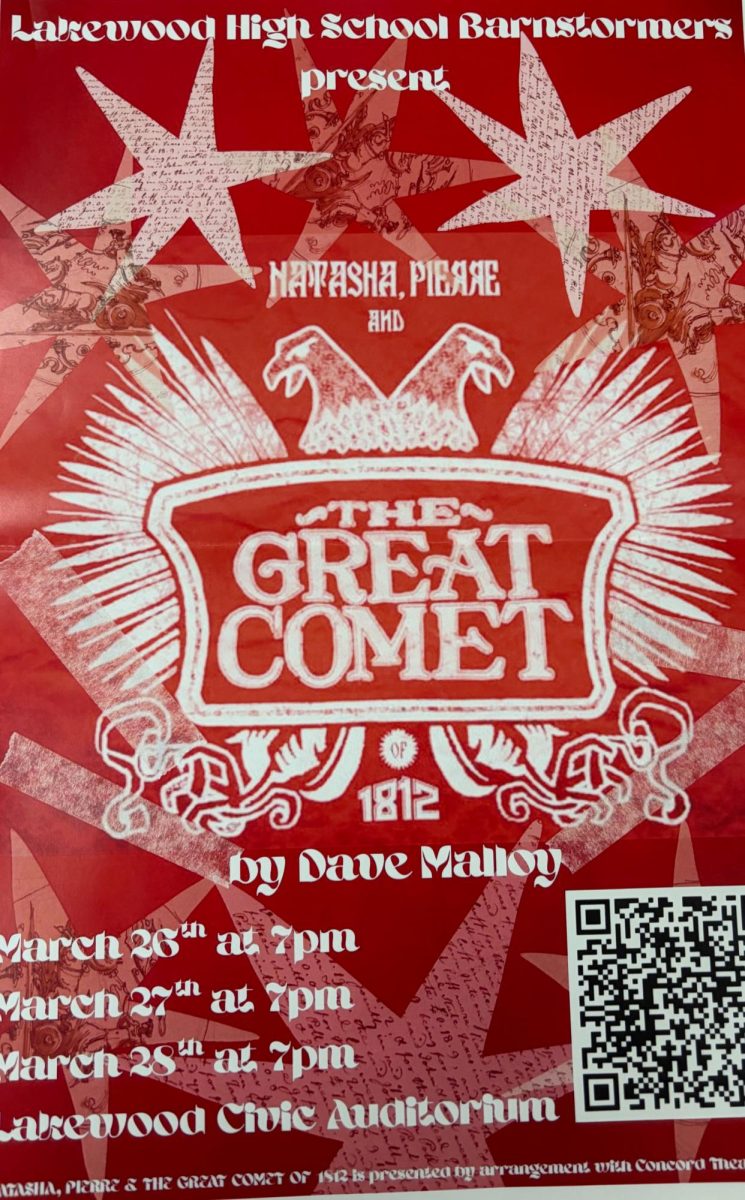
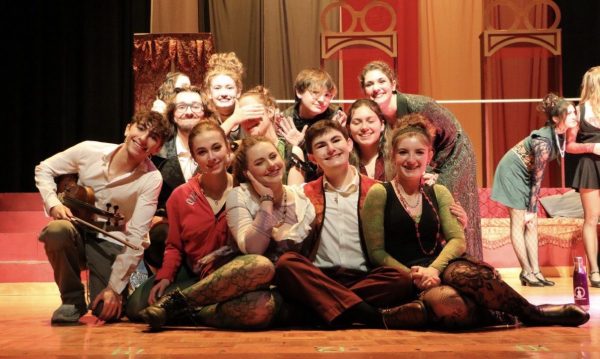
Lakewood High School Barnstormers just finished their presentation of the spring musical, Natasha, Pierre & The Great Comet of 1812 on March 28.
This story has deeper roots at Lakewood High School than what appears on the surface. Dave Malloy, who attended Lakewood High School, was the composer, lyricist, librettist and orchestrator of the play. Malloy adapted a small portion of Leo Tolstoy’s War and Peace.
Malloy’s success wasn’t handed to him by a talent scout or someone from Hollywood; it was built right in the classrooms and rehearsal spaces of Lakewood. On a Zoom call with Lakewood students and teachers, Lakewood High School choir teacher Rayna Brooks said Malloy shared an anecdote from his time at Lakewood: “His band teacher just handed him an accordion that somebody dropped off, and that accordion ended up in the show.”

The accordion did not just stay at Lakewood High School; it traveled to 19th-century Russia in the show and to the bright lights of New York City with Malloy, where he has earned 12 Tony Award nominations. It came full circle back to the Lakewood High School stage this March, though many do not know its full story.
Malloy’s story showed students that resources do not limit creativity, but are shaped by how individuals choose to use what is available to them.
Malloy’s process and work, especially with Natasha, Pierre & The Great Comet of 1812, stood out because it was entirely his own. As composer, lyricist, librettist and orchestrator, he built the show from a singular vision, allowing deeper connections among music, character and story. For students, this connection added a real and raw impact on how they connected to characters in the musical.
Students are also reminded of how unique their environment is, sharing a space once shared by accomplished artists. At LHS, that connection extends beyond the present moment. “I found that it’s very humbling for students, and it helps to show that the world is bigger than what we experience right now,” said Domenic Farinelli, Lakewood’s theater arts instructor.
Malloy is not just a representation or symbol of Lakewood; his fearless spirit still exists today. “If they kind of go above and beyond and they follow their passions, it’s not just going to carry them further outside of the school, but their legacy will also live on inside of the school,” said Clinton Steinbrunner, band director at LHS.
Another lesser-known fact about Dave Malloy is that he wrote one of the drum cadences still used in the Lakewood Marching Band today.
Reinforcing how awesome and full of opportunity Lakewood is and showing students that so many successful people have been in and out of these doors, encourages students to see themselves as part of a larger story — one where success is not distant but directly connected to where they are now.
Although the play has recently ended and the last notes have been played, Malloy’s legacy will remain present in Lakewood High School and the wider community. The story of the accordion is more than just a simple anecdote; it is a statement of what Lakewood students can accomplish.
The tools of greatness have been — and will continue to be — in the city of Lakewood and the high school. The hallways that students walk through every day were once the halls where a regular Lakewood student once walked, and who went on to redefine American theater.
This production has bridged the gap between being an ordinary student and aspiring to be a professional. By engaging with Malloy’s work, which was born in the same music and practice rooms of today, the Barnstormers have done more than just memorize lines or scenes. They have participated in a homecoming. Lakewood High School was a launching point for Malloy, who once stood where they stand on the stage.