





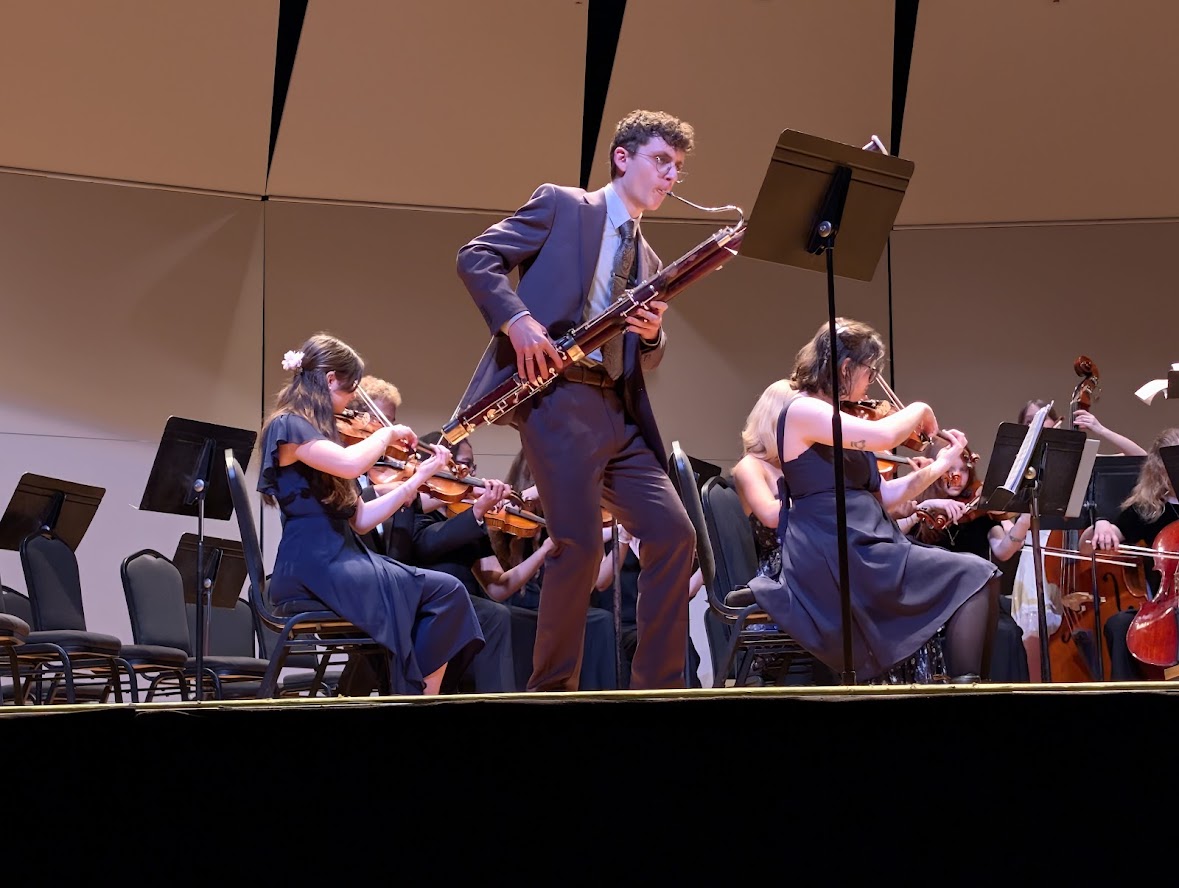
Both string and wind-playing seniors performed solos and concertos during the annual LHS Orchestra Spring Concert on Friday, April 24, in the Civic Auditorium, showcasing the skills they have developed throughout their four years at Lakewood High School. Alongside ninth-grade musicians, the seniors performed a range of classical and contemporary pieces designed to highlight the strengths of their individual instruments.
Concertos at the High School
A concerto is a complex piece of music designed by a composer to highlight the unique traits and strengths specific to the instrument for which it was composed. Concertos are a tradition in the musical field that has been around for hundreds of years.
Michael Dandron, orchestra director at Lakewood High School, described it by saying, “A concerto is a featured solo accompanied by an entire orchestra. So one person [is] standing in front of the orchestra, oftentimes playing [the piece] memorized, then an entire orchestra behind that person gives a canvas for the soloist to make their painting on.”
As for Lakewood High School, it has been a long-standing tradition that there be senior concertos during the Spring Orchestra Concert.
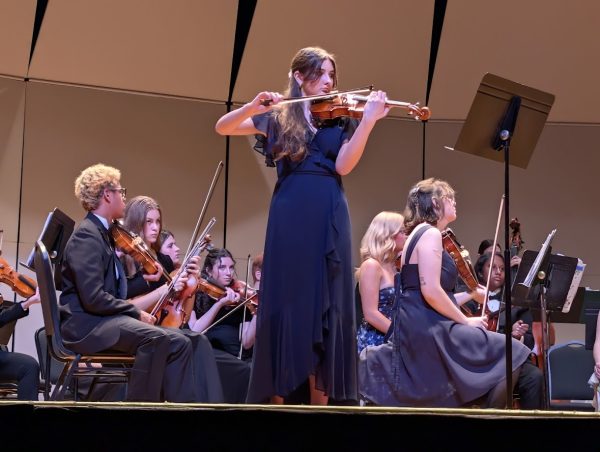
Until this year, any senior was permitted to present a concerto the year before and then possibly perform it for the Spring Concert. The process depends on several factors, including whether the music is accessible and not heavily restricted by copyright.
Once approved, students work closely with the director to determine whether the piece is appropriate for both the soloist and the orchestra in terms of difficulty and overall performance ability.
Interest in performing remained high this year, resulting in six concertos, one piano-accompanied solo, and one trio performance. “I’ve been vocal about my interest in doing one for a while. So as I got to this year, I asked them about it, [and] for a while it was like, ‘am I going to play with the orchestra, with the band, or am I going to do a different concerto?’ So it took a while to kind of settle on what we eventually settled on for the plan, which was [the Mozart Concerto] with the orchestra, and then I’m going to play the premier solo at the band concert with piano. [It was a] little of me asking about it, a little of them going, ‘Hey, do you want to do this?’” said senior bassoonist Alessio Matera.
The Music Played
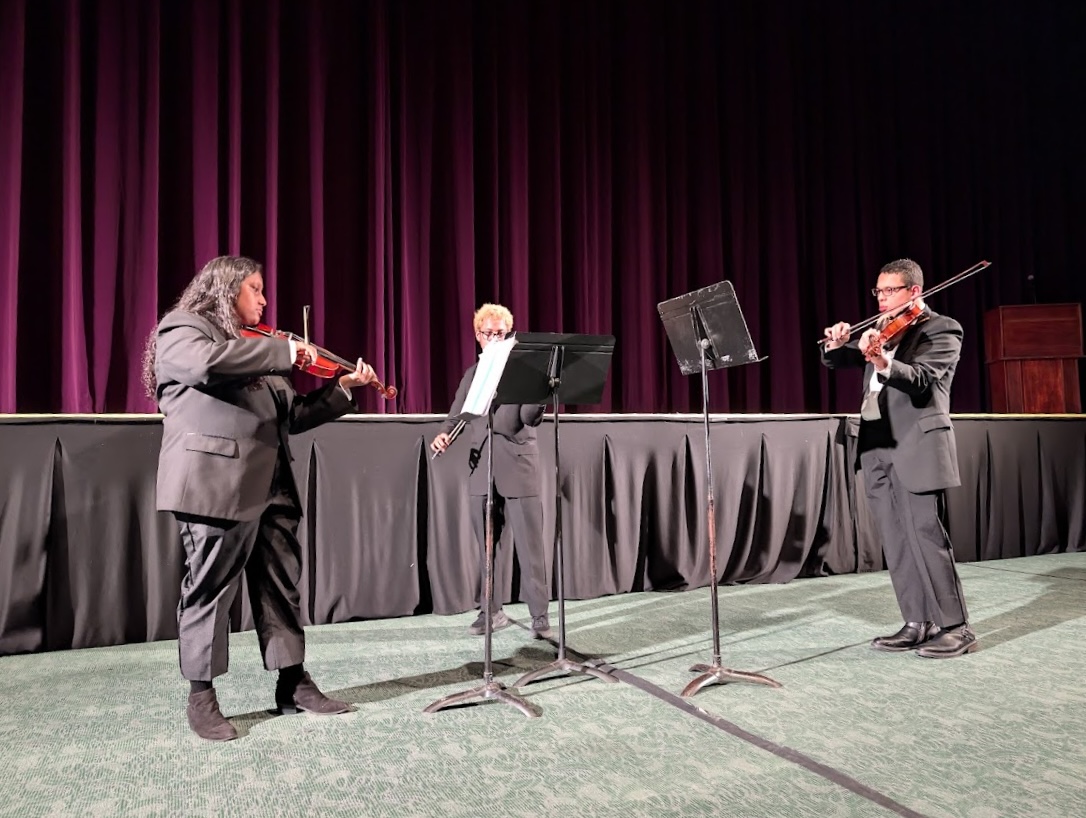
The evening featured a variety of performances from the senior musicians. Abby Peck performed the “Hungarian Rhapsody” concerto for cello by David Popper, while Abigail Kovach played the “Lars-Erik Larsson Double Bass Concertino.” Matera performed Mozart’s “Concerto in B-flat for Bassoon and Orchestra.” Thea Harkelroad played Ralph Vaughan Williams’ “The Lark Ascending,” and Csenge Sundem performed “Summer” from Antonio Vivaldi’s The Four Seasons. Nora Dunne performed “Élégie” by Gabriel Fauré, Stevie Williams played the “Accolay Violin Concerto No. 1” by Jean-Baptiste Accolay, and Freddie, Nolan, and Marissa Showers performed Sergey Taneyev’s “String Trio in D Major.”
The Story Behind the Music
Choosing and preparing a concerto is often a long and complicated process. Students spend months preparing challenging pieces while also balancing schoolwork, rehearsals, and other activities.
One performer who faced unexpected challenges was Nora Dunne. Originally, Dunne planned to perform Édouard
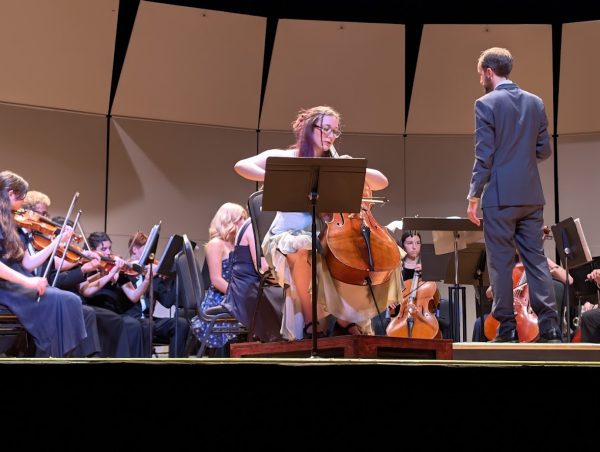
Lalo’s cello concerto as preparation for “Élégie,” which she considered more technically difficult. However, during the process, she discovered she had a bone tumor in her upper left arm, which she nicknamed Guadalupe, and underwent surgery to remove it. Despite the setback, Dunne chose to continue performing and ultimately decided to perform “Élégie” instead.
“I think it grew my confidence a lot, because with this piece specifically, I’ve grown a lot with my tone [and] gained a lot of mature musical skills that I didn’t have before. So being able to show that to everyone was really, really cool,” said Dunne.
Matera also described the thought process behind selecting his performance. He debated between the first and third movements of Mozart’s concerto before deciding on the first movement after discussions with his private lesson instructor.
“It’s a great concerto. I wanted to play something with the orchestra, so I felt like this was the perfect piece. By the time I hit the first note, I was just feeling excited and happy, and it was just a lot of fun — I really had a good time. Just to have this group of people supporting you who you know and have worked with for years, that’s an experience that I’m probably never [going to] get again,” said Matera.
Dandron explained that the experience benefits not only the soloists, but also the orchestra members accompanying them. “Playing as the soloist and in the orchestra, [they] gain a lot of body language skills, how to move and communicate just by raising and lowering your scroll (the tip of the neck of stringed instruments) or breathing. There’s a lot of [learning] how to follow one another. [They] learn about [the] hierarchy of balance, [and] the goal is to never cover up the soloist. Then there are the times that [the] orchestra should play out and go totally ‘ham.’ So it’s just about walking that line of knowing when [one is] important versus when [one is] accompaniment,” said Dandron.
Going Forward
The senior concerto tradition has remained an important part of the LHS Orchestra Spring Concert for many years, though Dandron acknowledged that adjustments may be needed in the future to balance the concert experience for all performers.
“I’ve tried to keep things mostly the same, [but] next year I might cap it as to how many concertos we have just so the other orchestras can spend a little more time performing. [This is] because there were ninth-grade orchestras who sounded stellar, but they played like one piece on their own, then one combined piece, and then they just kind of watched [the rest of the time]. That’s really the only change that I can think of, is trying to keep [the Spring Concert] engaging and interesting [by] shortening the concerto part of it just a little bit,” said Dandron.
Even with possible changes ahead, this year’s concert highlighted the dedication, resilience, and talent of Lakewood High School’s student musicians, while continuing a tradition that gives seniors one final opportunity to shine on stage.