









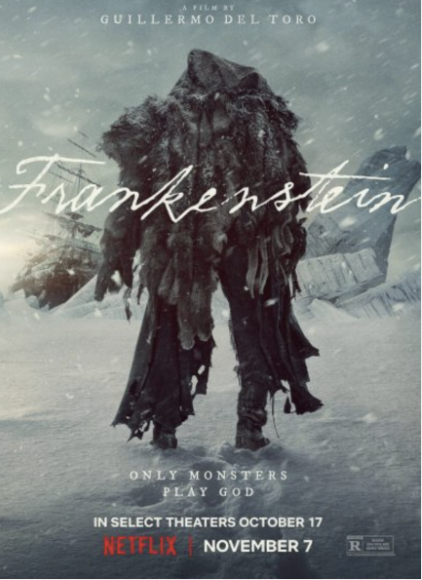
One of the most well-known stories in the world is that of the deranged scientist Victor Frankenstein and his death-defying creature. Guillermo del Toro’s 2025 Netflix original film, Frankenstein, is the most recent addition to enter this vast catalog.
Guillermo del Toro’s Frankenstein moves the timeline of the setting from the novel’s original 18th century to 19th-century Europe and follows the classic story of Dr. Victor Frankenstein attempting to create life. In doing so, he creates what he views as a monster and leaves it for dead. After escaping this near-death experience, the creature embarks on a journey of self-discovery, leading to years of a cat-and-mouse game between Victor and his creation as the creature seeks revenge.
The film is framed as sequential accounts told to an elderly traveler years later; first by Victor, and then by the creature after he has finally tracked down his creator. Divided into two sections — “Victor’s Tale” and “The Creature’s Tale” — the intentional structure allows both characters to be seen as main figures while still portraying Victor as the film’s antagonist, positioning the creature as a villainous, imposing force over Victor’s life. The structure also helps with the pacing of the lengthy film.
“Victor’s Tale” follows Victor from childhood through his life, marked by tragedy and loss. The death of his mother during the birth of his younger brother, physical and emotional abuse from his father due to unmet expectations and his longing for the woman engaged to his younger brother all shape his character. This section provides background for Victor’s future mistreatment of the creature, as he projects the same neglect he experienced from his father onto the creature for not living up to expectations. It serves as a kind of villain’s origin story for Victor. The buildup to the creation of the creature in Victor’s story is one of the best parts of the film, offering a deeper understanding of Victor’s actions and laying the groundwork for the creature’s motivations throughout the main conflict.
“The Creature’s Tale” takes up the second half of the film after “Victor’s Tale” concludes. This section follows the creature on a journey of self-discovery after Victor abandons him, continuing until the end of the movie. The creature’s portion features a simpler series of events than Victor’s for most of its duration. The creature is led through a series of experiences that ultimately lead him to find the life he always wanted with Victor, in someone else. When all of this is taken away, he begins a long journey of revenge. Initially, the creature has a limited vocabulary, so Jacob Elordi relies heavily on physical acting to convey complexity. Once Elordi is given more opportunity to showcase his acting ability, he delivers a performance full of depth and soul.
The narrations provide insight into the two leads’ motivations and help the viewer feel as if they are reading the original Frankenstein novel. However, these narrations also often make the film feel incoherent and lead it to rely on them to tell viewers how they are supposed to feel, rather than using the visuals to tell the story. The moments when the film gives the narration a break and allows the visuals to speak for themselves are the highlights of the film and the most memorable parts once the credits have rolled.
While the visuals are not given much room to shine in the storytelling, the film is still filled with eye-catching imagery and masterful use of its dark color palette. The visual style relies on muted earth tones, which makes the rare use of more vibrant colors — most often red — stand out more. These visuals are clearly meant to be seen on the big screen, but unfortunately, they are now available on Netflix.
Most of the film’s visuals feature grand Victorian set pieces, prosthetics that make the creature seem real, and stunning shots that tell their own story. However, the CGI leaves much to be desired. Fortunately, the film uses very little CGI, but when it does, it is usually used on plot points that are unnecessary and manage to take viewers out of the movie, possibly the worst aspect of the film.
Like the original book, del Toro’s Frankenstein is full of metaphors and symbolism. The novel is rich in religious imagery surrounding the creature, and the film certainly delivers in that aspect. But beyond the religious symbolism, the film introduces its own symbolism unique to the medium. One example is the numerous shots and scenes involving the creature that reflect flashbacks to Victor’s childhood earlier in the film. The most notable example is the deliberate decision to cast Mia Goth as both Elizabeth Lavenza, Victor’s love interest, and Claire Frankenstein, Victor’s mother.
Goth’s performance as both of these important characters is fantastic yet limited. She delivers a great performance in scenes filled with dialogue as well as those that allow the silence to linger and let the visuals and her expressions stand out. The main issue with Goth’s portrayal is that there isn’t enough of her. Many scenes could be improved with more physical presence from her characters or simply by allowing her presence to be felt more. When she is on screen or mentioned, she manages to be the emotional core of much of the film’s conflict and heart.
Guillermo del Toro’s Frankenstein is a masterful modern retelling of the classic tale that emphasizes various aspects to make it stand out from numerous other versions of this iconic story. The entire main cast delivers deep, complex performances that make the world of this fantastical tale feel realistic and grounded. Aside from occasional poor CGI and needing a bit more showing rather than telling, the visual style is breathtaking and tells a story of its own. Frankenstein exemplifies how to take a story as old as time and transform it into a unique retelling for a modern audience. Even if it couldn’t be on the big screen, watching del Toro’s Frankenstein is an experience that will leave a lasting impact on viewers long after the final line is spoken and the final shot is shown.
